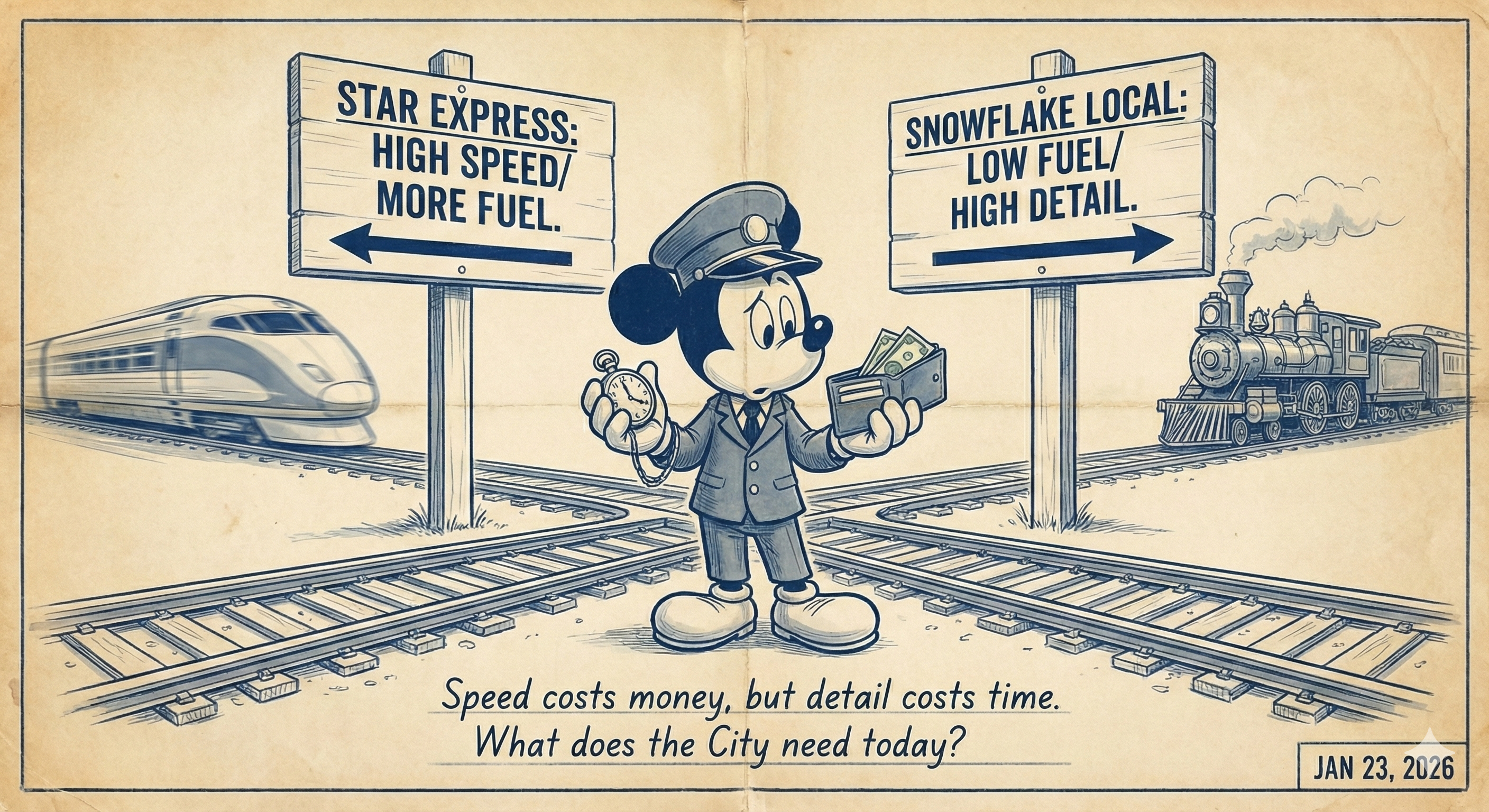
This is the final installment of our schema series. We’ve seen the Star Express and the Snowflake District. Now, it’s time for the ultimate showdown. How does Conductor Mickey decide which tracks to lay down for the “Invisible City”?
In the previous posts, we explored two very different ways to organize a subway station:
- The Star: Fast, flat, and simple.
- The Snowflake: Detailed, organized, and space-saving.
But in the real world of Data Engineering, you can’t always have both. You have to choose your priority: Speed or Storage?
1. The Head-to-Head Battle
Let’s put these two architectures in the ring. Who wins in each category?
| Feature | Winner | Why? |
|---|---|---|
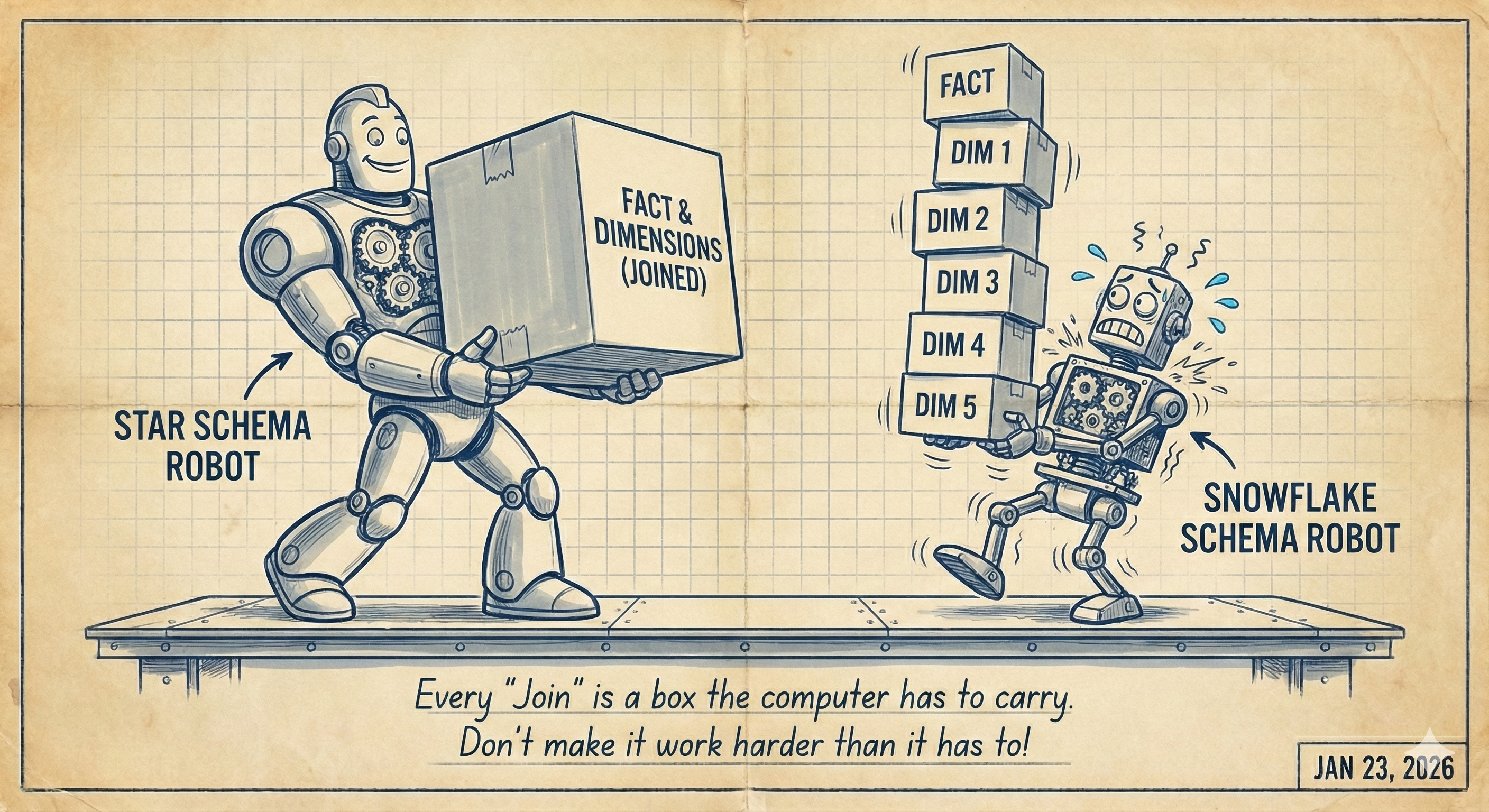
| Query Performance | Star | Fewer “transfers” (joins). The data train gets to the answer in one hop. |
| Storage Efficiency | Snowflake | No repeating words. Every piece of data is stored exactly once. |
| Ease of Use | Star | It’s much easier for “The Mayor” (Analysts) to write simple SQL queries. |
| Data Integrity | Snowflake | Less risk of “Update Anomalies.” Change a name once, it’s fixed everywhere. |
| Maintenance | Snowflake | Easier to update complex hierarchies and relationships. |
2. Mickey’s “Decision Tree”
Mickey doesn’t just flip a coin. He asks three specific questions before he starts digging tunnels:
Question 1: Is Storage Expensive?
In the old days (On-Premise), hard drives were expensive. We used Snowflakes to save every byte.
- Today: In the Cloud (Snowflake, BigQuery, Databricks), storage is cheap. We usually choose the Star because we care more about speed and compute efficiency.
Question 2: Who is the End User?
- If the user is an AI Model or a Power User, they can handle a complex Snowflake.
- If the user is a Business Manager using Power BI or Tableau, they want a Star. These tools are built to “drag and drop” Star Schemas perfectly.
Question 3: How Complex is the Hierarchy?
If your “Product” dimension has 50 different levels (Brand → Category → Sub-Category → Department), a Star table becomes too wide and messy. A Snowflake helps keep that complexity under control.
3. The “Hybrid” Secret (The Lakehouse Way)
In 2026, many engineers (and Mickey!) use a Hybrid Approach.
We might store data as a Snowflake in our Silver layer (to keep it clean and normalized) but then transform it into a Star in our Gold layer (so it’s lightning fast for the Mayor’s executive reports).
Conclusion: Which will you build?
There is no “wrong” answer, only the “right” answer for your specific city.
- Build a Star for speed and happy users.
- Build a Snowflake for complex data and perfect organization.