In our Invisible City subway system, we’ve already upgraded our shipping containers from old wooden crates (CSV) to futuristic, high-tech pods (Parquet). But a depot full of pods is still just a pile of boxes.
If a train crashes while unloading, or if two conductors try to move the same crate at once, you get a “Data Crash.” To solve this, Conductor Mickey uses a special system: Delta Lake.
But wait—is “Delta Lake” the same as a “Delta Table”? Let’s clear up the confusion with a trip to the Smart Depot.
1. Concept vs. Reality: Delta Lake vs. Delta Table
Many junior conductors get these two mixed up. Here is the simplest way to think about them:
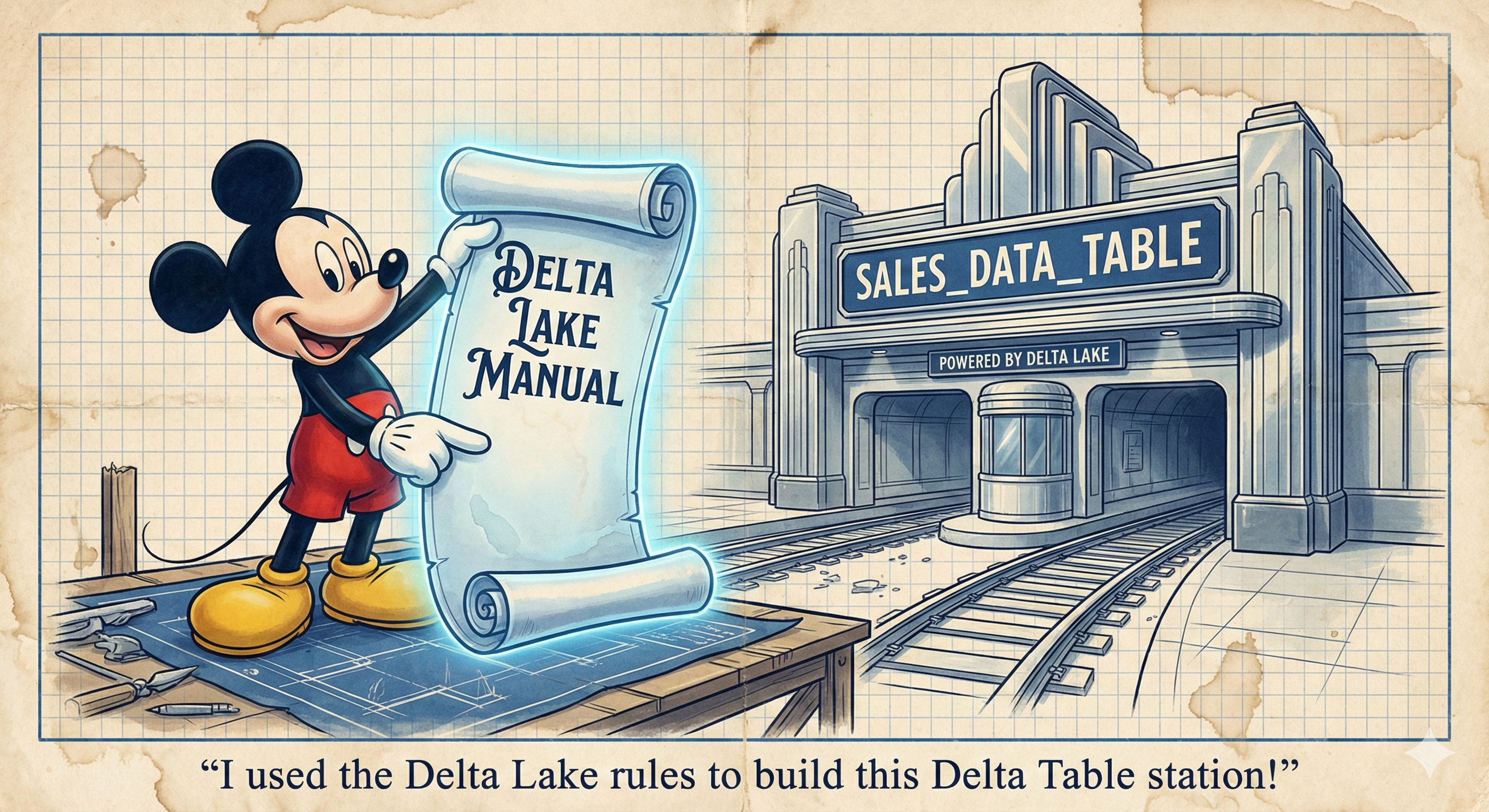
- Delta Lake (The Framework): This is the Subway Operating Manual. It is the set of rules and the “brain” that teaches your storage yard how to be smart, safe, and reliable.
- Delta Table (The Instance): This is a Specific Subway Station. It is a physical folder on your hard drive (or cloud storage) where the data lives.
Mickey’s View: “Delta Lake is the magic spell I use to make my messy yard behave like a high-tech terminal. When I build a station using that spell, I call it a Delta Table!”
2. The “Recipe” for a Delta Table
What is actually inside a Delta Table? If you opened the folder under a microscope, you would see two things working together:
- The Cargo (Parquet Files): These are the actual “shipping containers” full of data.
- The Brain (The Transaction Log): A secret folder called
_delta_log. This is a master ledger that records every single thing that happens to the table.
| Ingredient | The Analogy | Technical Role |
|---|---|---|
| Parquet | The Flour & Sugar | The actual data storage. |
| _delta_log | The Recipe Diary | The “Transaction Log” that tracks changes. |
| Delta Lake | The Chef’s Skills | The software that reads the diary and handles the cargo. |
3. Why Mickey Loves the “Smart Depot”
By using the Delta Lake framework, Mickey gets three “superpowers”:
A. The “Safety First” Policy (ACID Transactions)
Imagine Mickey is unloading 1,000 crates. Suddenly, the power goes out after crate #500.
- Without Delta: You have a half-finished mess. The “City Mayor” (the User) gets a report that is only 50% true.
- With Delta: It’s “All or Nothing.” Because of the Transaction Log, if the job isn’t 100% finished, Delta “hides” the partial work. The Mayor only sees the data once it’s perfect.
B. The “Time Machine” (Time Travel)
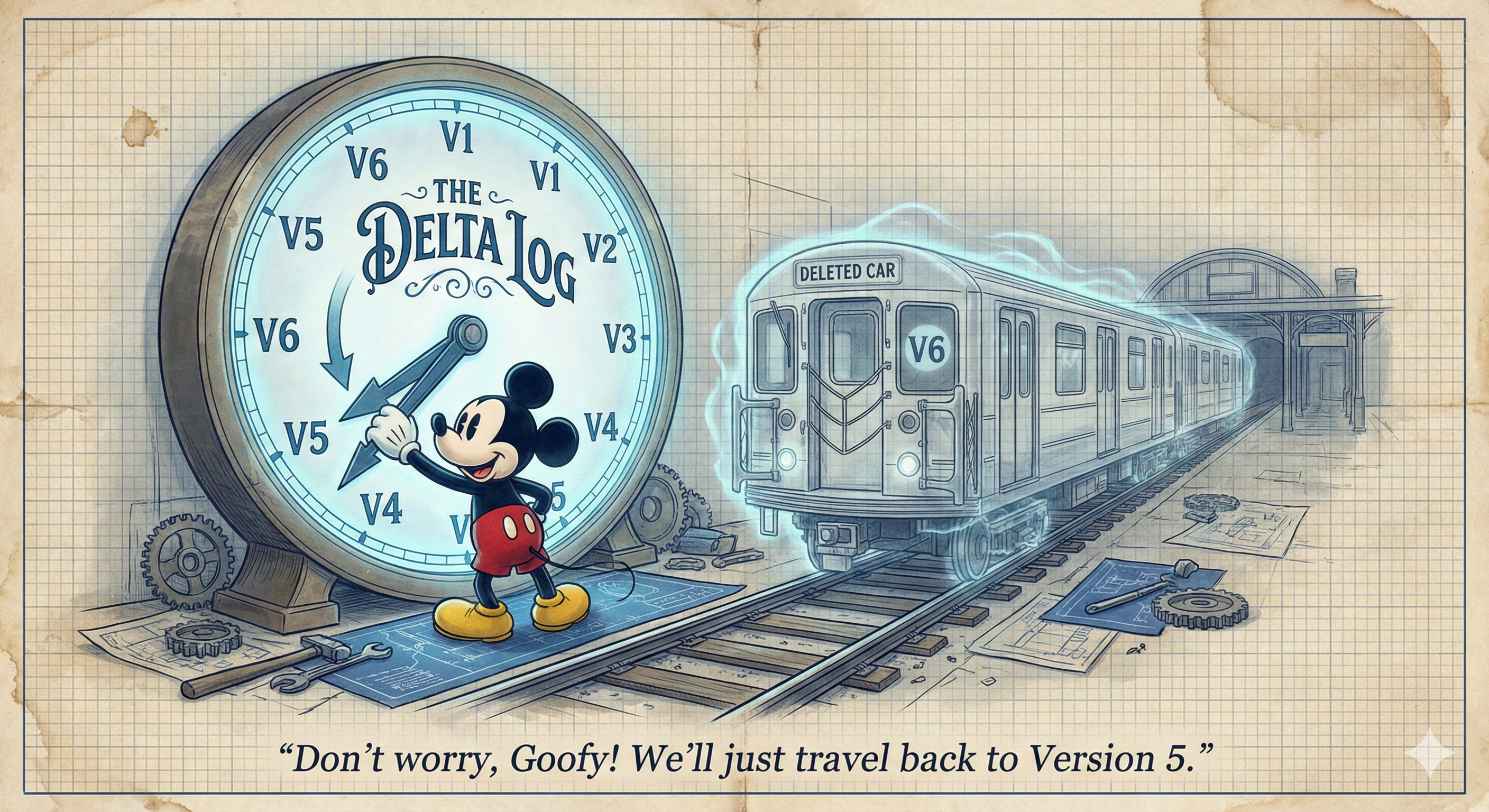
If Goofy accidentally deletes a car full of data, Mickey doesn’t panic. He looks at his _delta_log and turns a dial.
- Mickey’s Action: “Show me the station exactly how it looked at 10:00 AM yesterday.”
- The Result: Delta can “roll back” the station to a previous version instantly. This is officially called Point-in-Time Recovery.
C. The “Schema Police” (Enforcement)
If someone tries to put a “Bicycle” (text) into a car reserved only for “Apples” (numbers), Mickey stops them at the gate. This prevents “dirty data” from breaking the trains downstream.
Conclusion: Don’t Just Store Data—Manage It
In the Invisible City, we don’t just want a pile of files; we want a reliable system. Using Delta Lake to build your Delta Tables ensures that your data is safe, your history is saved, and your city stays organized.
Have you ever wished you had an “Undo” button for your database? Tell Mickey about your biggest data “accident” in the comments!